Rufen Sie uns jederzeit an
+8613570976228




You face a crowded shelf in 2026. Coating formulations vary widely, substrate grades differ, and price points spread across a broad range. How do you pick the right MMO Coating Electrode for your specific application?
Start with four selection criteria: technical performance, application fit, regulatory compliance, and total cost of ownership. This article walks through them as a step-by-step decision framework.
Before you compare options, build a solid reference point. Understanding MMO Coating Electrode technology helps you read supplier data with confidence and ask sharper questions.
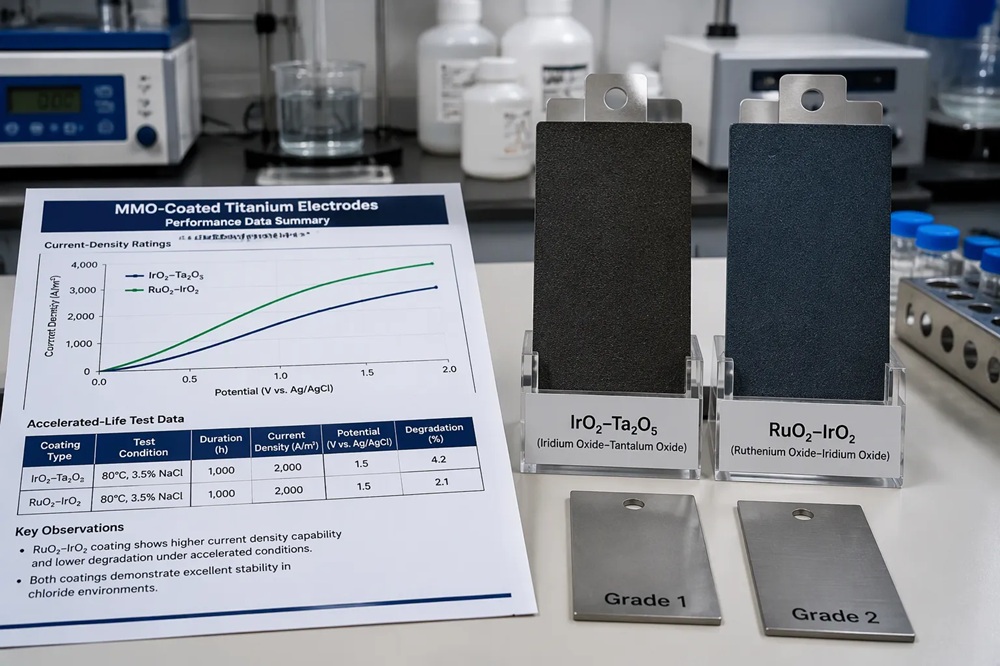
Performance data separates serious candidates from marketing claims. Treat this filter as a pass-or-fail test. An electrode that cannot meet your current density and lifetime targets will fail in service, no matter how attractive its price looks.
Coating composition decides where an electrode performs best. Two families dominate the market, and each has a clear home.
Iridium oxide–tantalum oxide coatings suit oxygen-evolving environments. They tolerate acidic conditions and hold up well under high current density. Chlorine production, electroplating, and cathodic protection systems commonly rely on this family.
Ruthenium oxide–iridium oxide coatings shine in chlorine-evolving service. They offer low overpotential for chlorine evolution and deliver strong efficiency in chlor-alkali and hypochlorite generation. The iridium content improves stability and extends service life in demanding duty.
Neither family wins everywhere. Match the coating to your dominant electrochemical reaction, and ask the supplier which formulation they recommend for your electrolyte.
|
Coating Family |
Best Fit |
|
Iridium oxide–tantalum oxide |
Oxygen evolution, acidic service, high current density |
|
Ruthenium oxide–iridium oxide |
Chlorine evolution, chlor-alkali, hypochlorite generation |
Substrate selection matters just as much. Grade 1 titanium offers higher purity and better corrosion resistance. Grade 2 titanium costs less and performs well in many industrial duties. Your choice depends on electrolyte aggressiveness and expected service life. A premium coating on an undersized substrate still limits performance.
Request current-density ratings and accelerated-life test data from every supplier. These two documents reveal how the coating behaves under real load. Compare test conditions carefully. A lifetime figure means little without the current density, electrolyte, and temperature behind it.
Current density and coating lifetime trade off against each other. Push an electrode harder, and the coating wears faster. Suppliers usually publish a rated current density for continuous duty. Ask for the derating curve or test data that shows how lifetime changes at higher loads.
Design your system around the rated value with a safety margin. This margin protects your MMO Coating Electrode during startup surges and process upsets. It also absorbs the natural degradation that occurs over years of service.
Accelerated-life testing compresses years of wear into weeks. Review the test protocol before you trust the result. Confirm the electrolyte, temperature, and current density match your application. A test run under milder conditions overstates real-world life.
Compare lifetime data across suppliers on equal terms. Normalize results to your operating current density where possible. Then weigh expected life against replacement cost and downtime. This comparison feeds directly into the cost analysis later in this framework.
Performance comes first for good reason. Get the coating and substrate right, and every later decision becomes easier.
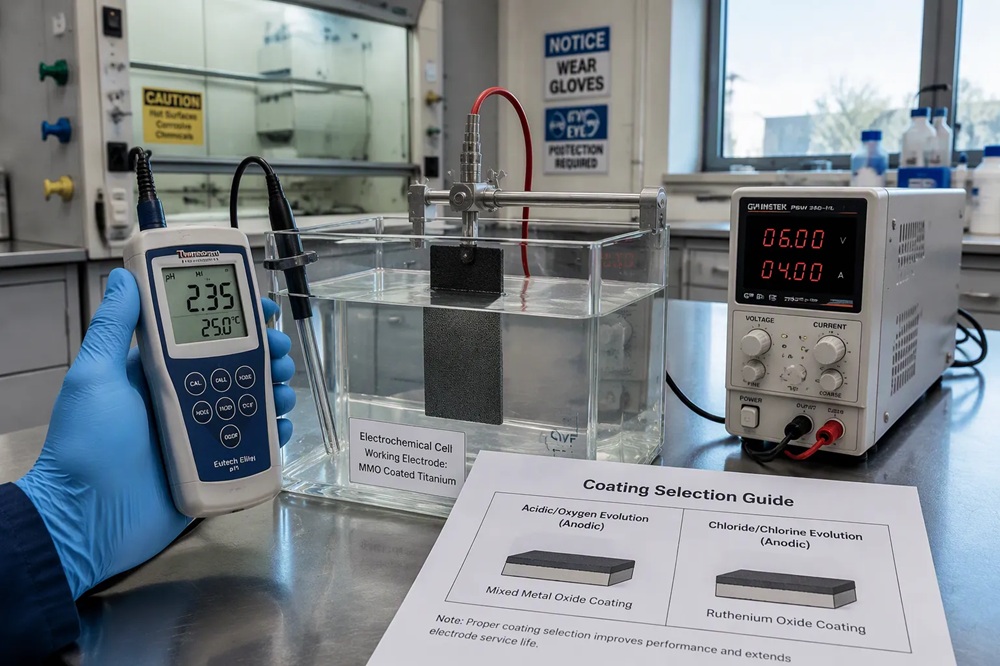
Performance data tells you what an electrode can do. Your process tells you what it must survive. This second filter checks whether a candidate actually belongs in your tank, your pipeline, or your cell.
Electrolyte chemistry drives the dominant reaction at the anode surface. Oxygen evolution and chlorine evolution place very different demands on a coating. Your first job is to name the reaction your process depends on, then confirm the supplier designed the coating for it.
pH range narrows the field further. Acidic service favors iridium oxide–tantalum oxide coatings, which hold their structure under low pH and high current density. Neutral and alkaline chloride service often points toward ruthenium oxide–iridium oxide coatings, where chlorine evolution efficiency matters most. Neither family is universally superior. Each one fits a defined window, and your electrolyte defines that window.
Watch for mixed electrolytes. Brine with organic additives, wastewater with fluctuating chloride content, and plating baths with changing composition all complicate the picture. Share the full chemistry with your supplier, including trace species and expected concentration swings. A coating rated for pure sodium chloride solution may behave differently in your real bath.
|
Service Condition |
Coating Family That Fits Best |
|
Acidic electrolyte, oxygen evolution |
Iridium oxide–tantalum oxide |
|
Chloride-rich electrolyte, chlorine evolution |
Ruthenium oxide–iridium oxide |
|
Mixed or fluctuating chemistry |
Confirm with supplier testing |
Temperature accelerates coating degradation. Higher operating temperatures shorten service life for any coating family, so ask for lifetime data at your actual temperature rather than at ambient conditions. If your supplier only publishes room-temperature figures, request test data closer to your operating range.
Duty cycle shapes the wear pattern just as strongly. Continuous operation at steady current treats the coating gently. Frequent power cycling, polarity reversal, and current interruptions stress the coating through expansion and contraction. Reverse-polarity cleaning cycles deserve special attention. Tell your supplier how often you reverse polarity and for how long.
Match the electrode to the full duty profile, not just the peak load. A plant that runs eight hours a day at moderate current needs a different specification than one that runs around the clock at rated maximum. Document your cycle pattern, your startup surges, and your shutdown routine. Then ask each supplier to confirm their MMO Coating Electrode suits that pattern.
Your company may offer every option discussed here, and that is precisely why each one deserves an honest fit assessment. The right answer depends on your electrolyte, your pH, your temperature, and your duty cycle. Gather those four facts before you compare quotes. They will eliminate unsuitable candidates quickly and leave you with a shortlist worth serious evaluation.
Compliance starts with management system certificates. Ask every supplier for a current ISO 9001 certificate for quality management and an ISO 14001 certificate for environmental management. Check the certificate scope. A valid certificate that covers a different plant or product line tells you little about the electrode you plan to buy. Confirm the issuing body and the expiry date as well.
Next, request the technical reports that describe the coating itself. A coating adhesion report shows how well the active layer bonds to the titanium substrate. A coating thickness report confirms the loading you specified. Both documents should reference the test method used, so you can compare suppliers on equal terms. Accelerated life test data belongs in this package too. Review the test conditions against your own operating current density, electrolyte, and temperature.
Your procurement team and your auditors will ask for a specific document set. Confirm that set early, before you place an order. Typical requests include the certificates above, the coating reports, and the accelerated life test data. Some buyers also need a material safety data sheet and a declaration of conformity.
Build a checklist and share it with each candidate supplier. Ask them to confirm in writing which documents they can provide and how quickly. A supplier who hesitates on basic paperwork may slow your audit later. Keep the signed checklist in your purchasing file. It protects you during internal reviews and gives your quality team a clear reference when the electrodes arrive.
A low price per piece can hide a high cost of ownership. Compare the purchase price against expected service life, replacement labor, and production downtime. An electrode that costs less upfront but fails sooner may cost more across a decade of operation.
Build a simple lifetime cost picture. Multiply the number of replacements you expect by the price per piece. Add the labor hours for each changeout and the value of lost production during every shutdown. Then compare that total across candidates. The cheapest quote rarely wins this comparison.
Ask suppliers for lifetime estimates at your actual current density and temperature. Use those figures in your calculation rather than catalog values measured under milder conditions. A conservative estimate protects your budget from surprises.
Platinum-coated titanium earns a place on your shortlist under specific duty conditions. These include service where the coating must resist aggressive chemistry, frequent polarity reversal, or operating profiles that stress conventional coatings. In such cases, the higher upfront price can pay back through longer service intervals and fewer changeouts.
Evaluate a Platinum Coating Titanium Electrode alongside your MMO candidates when your duty profile favors it. Request the same performance data you demanded from every other supplier: current-density ratings, accelerated-life results, and coating reports. Compare all options on equal terms.
Your MMO Coating Electrode remains a strong fit for many applications, and this framework does not push you toward one answer. The right choice depends on your electrolyte, your duty cycle, and your lifetime cost calculation. Run the numbers, then decide.
Run the sequence in order: performance first, then application fit, then compliance, then cost. A smart choice in 2026 means matching the MMO Coating Electrode to your electrolyte, duty cycle, and lifetime cost calculation. The lowest price rarely survives that comparison.
Before you scale up, verify every supplier claim. Request samples or test reports and confirm the data reflects your operating conditions. A Platinum Coating Titanium Electrode deserves a place on your shortlist when your duty profile favors it, so compare it on equal terms with the same performance data.
Ruthenium oxide–iridium oxide coatings fit chlorine-evolving duty best. They deliver low overpotential and strong efficiency in chlor-alkali and hypochlorite generation. Confirm the recommendation with your supplier against your actual electrolyte.
No. Current density and coating life trade off against each other. A high rating shortens service life under hard driving. Design around the rated value with a safety margin, and compare lifetime data at your own operating conditions.
Ask for current ISO 9001 and ISO 14001 certificates, a coating adhesion report, a coating thickness report, and accelerated life test data. Confirm the certificate scope covers the plant and product line you plan to buy.
Compare total lifetime cost, not price per piece. Multiply expected replacements by unit price, then add changeout labor and lost production during each shutdown. Use lifetime estimates measured at your current density and temperature.
Consider it when your duty profile includes aggressive chemistry, frequent polarity reversal, or operating patterns that stress conventional coatings. Request the same current-density ratings, life test results, and coating reports you asked of every other candidate, then compare on equal terms.
Copyright @ Esegen (Guangzhou) Technology Co., Ltd Alle Rechte vorbehalten.
 Netzwerk unterstützt