Rufen Sie uns jederzeit an
+8613570976228




Detaillierte Erklärung von Titananoden
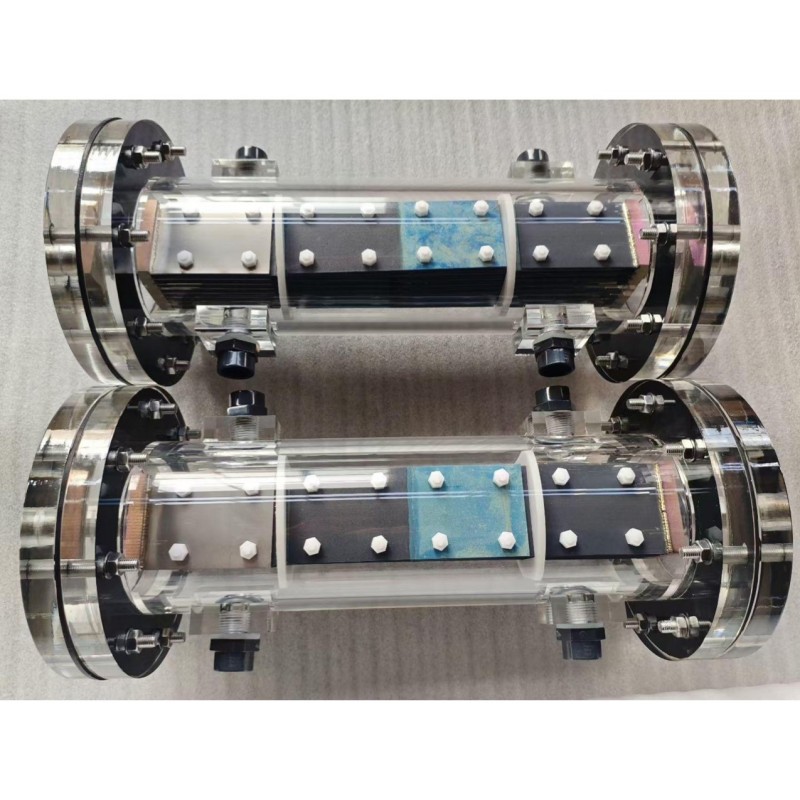
Was ist eine Titananode?
Eine Titananode, vollständig als Titan-basierte Anode bezeichnet Metalloxidbeschichtete Titananode (MMO) wird auch als DSA (Dimensionsstabile Anode) bezeichnet. Sie verwendet Titan als Substrat, das mit einer durch Bürsten aufgebrachten Edelmetallschicht beschichtet ist, was ihr eine ausgezeichnete elektrokatalytische Aktivität und Leitfähigkeit verleiht.
Klassifizierung von Titananoden:
Anoden werden nach dem bei der elektrochemischen Reaktion an der Anode entstehenden Gas klassifiziert: Anoden, die Chlorgas entwickeln, werden als chlorentwickelnde Anoden bezeichnet, wie beispielsweise mit Ruthenium beschichtete Titanelektroden. Anoden, die Sauerstoff entwickeln, werden als sauerstoffentwickelnde Anoden bezeichnet, wie beispielsweise mit Iridium beschichtete Titanelektroden und mit Platin beschichtete Titangewebe/-platten.
Chlorbildende Anoden (Ruthen-basierte, beschichtete Titanelektroden): Sie werden in Elektrolyten mit hohem Chloridionengehalt eingesetzt, typischerweise in Salzsäureumgebungen, bei der Meerwasserelektrolyse und bei der Soleelektrolyse. Entsprechende Produkte unseres Unternehmens sind Ru-Ir-Ti-Anoden und Ru-Ir-Sn-Ti-Anoden.
Sauerstoffentwickelnde Anoden (Iridium-beschichtete Titanelektroden): Als Elektrolyt dient üblicherweise Schwefelsäure. Zu den Produkten unseres Unternehmens gehören Ir-Ta-Anoden, Ta-Sn-Anoden und Hochiridium-Anoden.
Platinbeschichtete Anoden (Platin-Titan-Gewebe/Platin-Titan-Platte): Titan bildet das Basismaterial und ist mit dem Edelmetall Platin beschichtet. Die Schichtdicke beträgt üblicherweise 1–5 Mikrometer (µm). Die Maschenweiten des Platin-Titan-Gewebes liegen typischerweise bei 12,7 × 4,5 mm oder 6 × 3,5 mm.
Anodenauswahl: Sollten Kunden unsicher sein, welche Anode sie verwenden sollen, benötigen wir von ihnen die Bereitstellung der Arbeitsbedingungen und die Durchführung der Elektrolyse:
1. Stromdichte pro Quadratmeter (Stromstärke, die von einer einzelnen Anode aufgenommen wird, geteilt durch die Elektrodenoberfläche).
2. Temperatur.
3. pH-Wert.
4. Zusammensetzung und Anteile der Lösung.
5. Das hergestellte Produkt oder der vorgesehene Verwendungszweck usw.
Welche Funktion hat die Metalloxidbeschichtung auf Titananoden?
Durch die Anwendung verschiedener Beschichtungen werden die Leitfähigkeit und die elektrokatalytische Aktivität verbessert, der Elektrolyse-Reaktionsprozess gefördert und die Lebensdauer der Anode in unterschiedlichen Betriebsumgebungen verlängert, wodurch der gewünschte Nutzungseffekt erzielt wird.
Das Problem der Metalloxidschichtdicke auf Titananoden:
Die Hauptkomponente, die für die elektrokatalytische Reaktion verantwortlich ist, ist das Edelmetall in der Beschichtung. Nur wenn der Edelmetallgehalt den Anforderungen entspricht, ist der einwandfreie Betrieb des Anodenprodukts gewährleistet. Die Schichtdicke ist lediglich ein äußeres Merkmal, das hauptsächlich durch die Anzahl der Beschichtungsdurchgänge und die Konzentration des Lösungsmittels bestimmt wird. Sie steht in keinem direkten Zusammenhang mit dem Edelmetallgehalt. Eine zu dicke Beschichtung kann sogar anfälliger für Abblättern sein.
Was ist Anodenpassivierung?
Was ist die Passivierung von Metallen? Ein Eisendraht löst sich in verdünnter Salpetersäure schnell auf. In konzentrierter Salpetersäure hingegen stoppt die Auflösung nahezu vollständig. Wird der Eisendraht anschließend wieder in die verdünnte Salpetersäure gegeben, löst er sich nicht mehr auf. Selbst unter dem Mikroskop sind keine Veränderungen an der Drahtoberfläche sichtbar. Der Eisendraht befindet sich nun im passivierten Zustand. Auch eine Anode hat im elektrochemischen Betrieb eine begrenzte Lebensdauer. Steigt die Spannung sehr hoch an und fließt praktisch kein Strom mehr, verliert die Anode ihre Funktion. Dieses Phänomen wird als Anodenpassivierung bezeichnet.
Was sind die Hauptfaktoren, die die Lebensdauer der Anode beeinflussen?
1. Stromdichte: Die Stromdichte verhält sich umgekehrt proportional zur Anodenlebensdauer. Höhere Stromstärken führen zu einer kürzeren Anodenlebensdauer. Die Anoden unseres Unternehmens sind für eine Stromdichte von maximal 2000 A/m² ausgelegt. Es wird empfohlen, diesen Wert nicht zu überschreiten. Vermeiden Sie außerdem häufige Stromschwankungen.
2. Titansubstrat: Das Substratmaterial besteht in der Regel aus Reintitan der Güteklasse TA1 oder höher. Bei unzureichender Substratreinheit wird die Korrosionsbeständigkeit deutlich beeinträchtigt, was die Lebensdauer der Anode erheblich verkürzt.
3. Elektrolyt: Der Elektrolyt darf keine Fluoridionen (F⁻), Cyanidionen (CN⁻) oder Sulfidionen (S²⁻) enthalten. Deren Vorhandensein beeinträchtigt die Lebensdauer der Anode erheblich.
4. Polaritätsumkehr (Stromumkehr): Die Polaritätsumkehr ist eine gängige Methode zur Entkalkung von Anoden. Durch Umpolen löst sich der an der Kathode haftende Belag, wodurch die Entkalkung erreicht wird. Verwenden Sie zur Polaritätsumkehr ein Netzteil, das die positiven und negativen Pole langsam umschalten kann. Eine abrupte Polaritätsumkehr ist unzulässig.
5. Häufige Stromunterbrechungen: Wenn kein Strom fließt, kann das längere Eintauchen der Beschichtung in die Lösung erhebliche Schäden verursachen. Daher ist es ratsam, bei Nichtgebrauch der Anode einen sehr geringen Strom aufrechtzuerhalten, um den Stromkreis aktiv zu halten. Bei längerer Nichtbenutzung entnehmen Sie die Anode aus der Flüssigkeit, spülen Sie sie mit Wasser ab, trocknen Sie sie und lagern Sie sie ein.
6. Mechanische Beschädigung: Die Anodenoberfläche darf keine Beschädigungen aufweisen. Selbst kleine Kratzer, die einen Teil der Beschichtung beschädigen, können zu schneller Korrosion/Passivierung der Anode und damit zu deren Ausfall führen. Gehen Sie bei der Installation und Verwendung vorsichtig mit der Anode um, um Stöße zu vermeiden.
7. Kurzschluss: Der Kontakt zwischen Anode und Kathode im eingeschalteten Zustand ist verboten. Der bei einem Kurzschluss entstehende Strom kann sehr hoch sein und die Elektrodenplatten durchbrennen.
8. Temperatur: Die Anodenlebensdauer ist umgekehrt proportional zur Temperatur. Die Anoden unseres Unternehmens sind für Temperaturen von 40–60 °C ausgelegt. Es wird empfohlen, 60 °C nicht zu überschreiten.
Vorteile von Titananoden:
1. Dimensionsstabil (Substrat löst sich nicht auf), Elektrodenabstand bleibt unverändert, wodurch eine stabile Zellspannung gewährleistet wird.
2. Niedrige Betriebsspannung, reduzierter Stromverbrauch, Einsparung von ca. 20 % im Vergleich zu Bleianoden.
3. Hohe Reinheit des Kathodenprodukts.
4. Es bildet sich kein Anodenschleim, die Zelle wird nicht verunreinigt.
Leichtgewicht, reduziert den Arbeitsaufwand.
Das Substrat kann wiederverwendet werden.
Copyright @ Esegen (Guangzhou) Technology Co., Ltd Alle Rechte vorbehalten.
 Netzwerk unterstützt